
SBP-SAT on GPU: closing the Triton–CUDA gap
How a masked, branchy Triton kernel ran at 36% of hand-tuned CUDA — and how restructuring the algorithm (not tuning the kernel) got it to 68%, at the STREAM roofline. 2D Poisson, 4th-order SBP + SAT, n=1025 in fp64, Tesla T4.
The setup
The operator is a 2D Laplacian discretized with 4th-order summation-by-parts
(SBP) finite differences in the interior, one-sided boundary closures, and
simultaneous approximation terms (SAT) imposing Dirichlet boundaries weakly.
Diagonal norm, 1.05M unknowns, fp64. The hot loop is the sparse matvec
y = A x — a GMRES solve needs dozens of them.
Three implementations of the same matvec:
- Triton v1 — one kernel, masked loads/stores, runtime branches selecting the stencil per grid point.
- Triton v2 — nine kernels over disjoint write-sets (below).
- CUDA — hand-written: tiled shared-memory and direct global-memory variants, CUDA-event timed.
Metric: wall-clock ms per matvec, plus effective GB/s against the STREAM roofline (244.6 GB/s on this T4).
v1: the gap
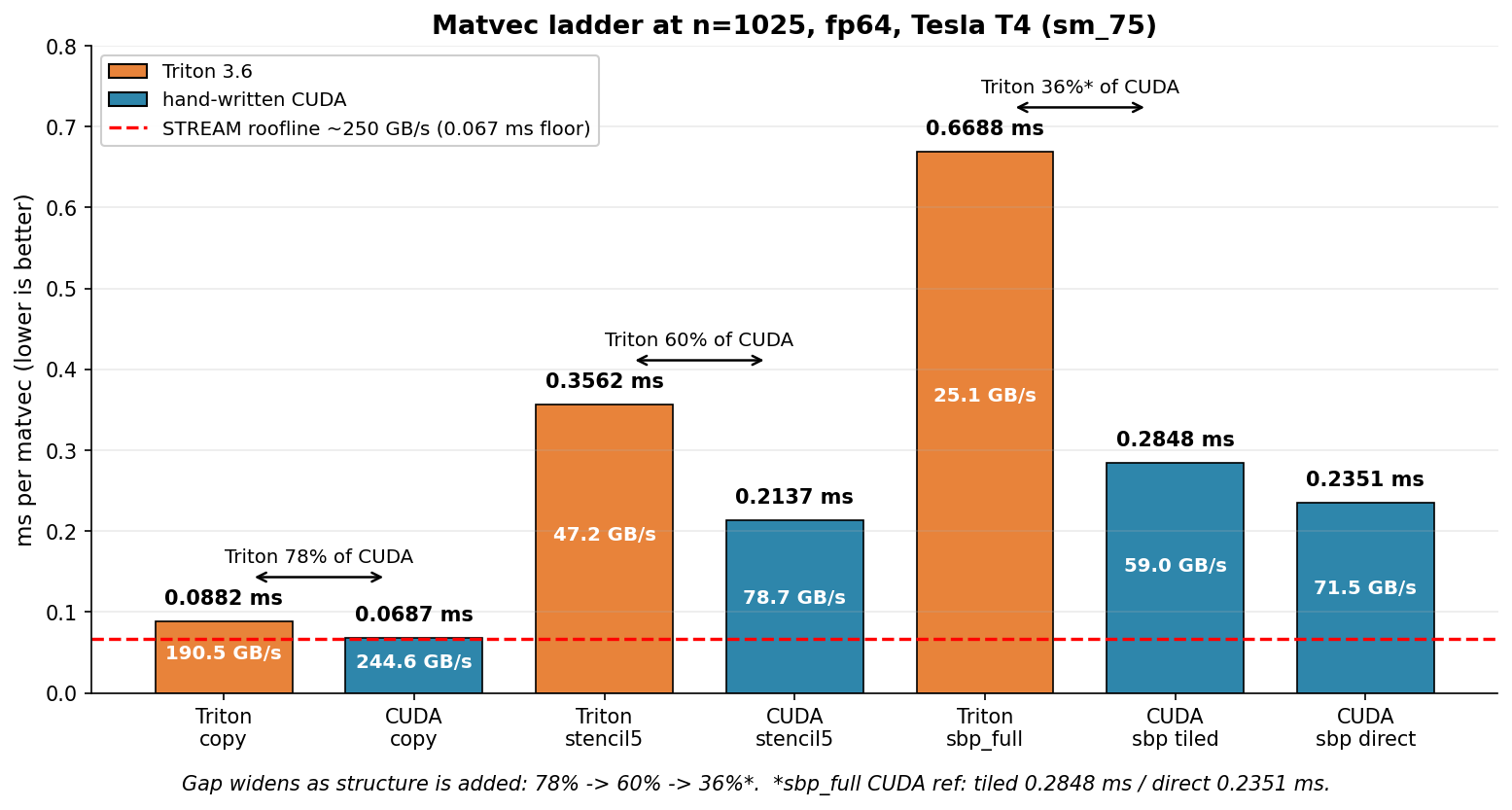
| kernel | Triton | CUDA | Triton/CUDA |
|---|---|---|---|
| copy | 0.088 ms | 0.069 ms | 78% |
| stencil5 | 0.185 ms | 0.110 ms | 60% |
| sbp_full | 0.669 ms | 0.236 ms | 36% |
The more complex the kernel, the worse Triton did. That’s the signature of a codegen problem, not a hardware problem.
Autopsy: why v1 was slow
I dumped the SASS for the v1 kernel. Out of 2,760 instructions, only 201 were DFMA — 7.3% of the instruction stream did real arithmetic:
- 184 of 377 global loads were predicated (masked);
- 354 FSEL plus select scaffolding (27.8%) existed only to emulate masked loads;
- 152 registers per thread → 384 threads/SM → 18.75% occupancy;
- zero vectorized memory accesses.
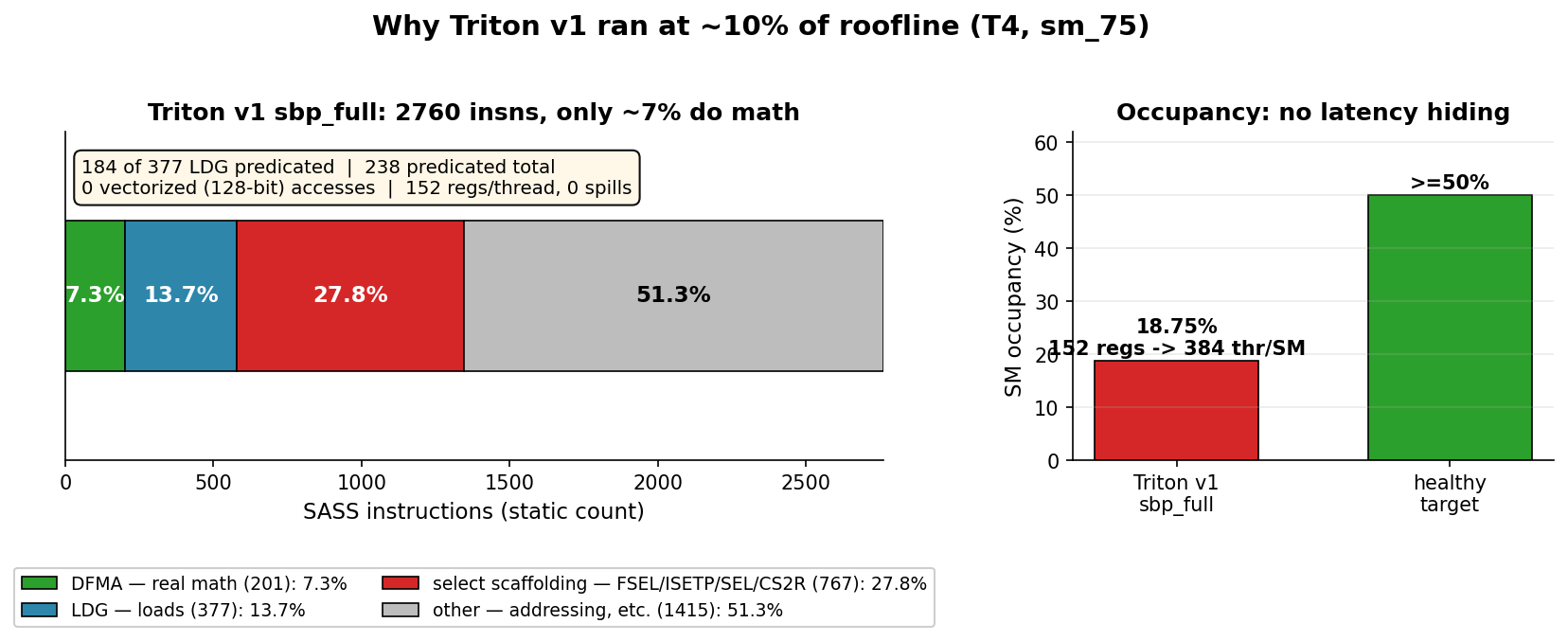
Root cause: the masked, always-execute-both-paths structure. Every thread loaded both the interior and boundary stencil paths and selected afterward. No compiler flag fixes an algorithm shaped like this.
v2: restructure, don’t tune
The fix was to change what each thread writes, not how it computes. The grid
is partitioned into 9 disjoint write-sets: one branch-free interior kernel
(i,j ∈ [4, n−5], pure 5-point stencil, zero masked loads) plus 8 boundary
rectangles. The stencil structure in each rectangle is chosen by compile-time
constexprs — the generated code for each part is a straight-line sequence
with no runtime branches and no masked loads.
This also settled a real correctness hazard: the SAT penalty touches corner points from two sides, so a naive split would have two threads racing on the same grid point. Here every point has exactly one writer thread — the corner’s double SAT term is added locally by its owning thread. Race-free by construction, not by synchronization.
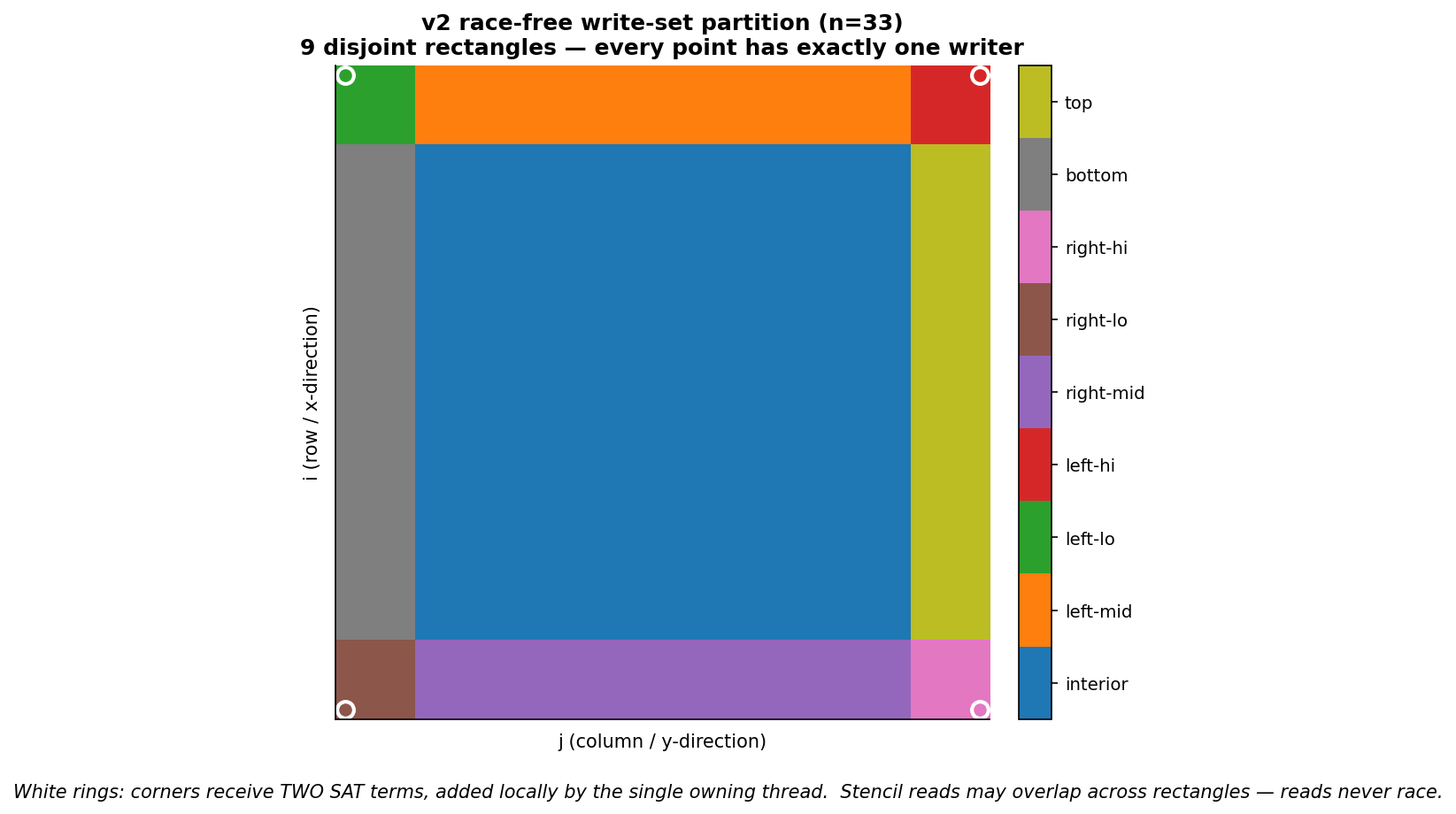
Verification before benchmarking: the split algorithm matches the assembled sparse matrix to ~3e-16 on CPU, and the compiled PTX shows zero predicated loads and zero fp32 ops.
Rematch verdict
Correctness on the T4: 1.639e-16 vs a torch fp64 reference. Then:
| kernel | ms | effective GB/s |
|---|---|---|
| copy | 0.0887 | — |
| sbp_interior (BLOCK=128, 4 warps) | 0.2968 | 278.7 |
| sbp_boundary (8 parts) | 0.1896 | — |
| sbp_full (v2) | 0.3499 | 241.3 |
That’s 1.91× faster than v1 (0.669 ms), now within 1.48× of hand-tuned CUDA tiled (0.236 ms) — and the effective bandwidth sits at the STREAM roofline. The remaining gap is memory reuse (CUDA’s shared-memory tiling), not instruction overhead.
One war story: the first rematch run failed — the fail-fast assert tripped
at 1.7e-08 instead of ~1e-16. The algorithm was proven correct on CPU, so it
wasn’t a math bug: Colab’s triton 3.6.0 was silently demoting np.float64
scalar kernel arguments to fp32 (my clean check had run on 3.8.0 — a
version-specific behavior). The fix: constants now ride in a device fp64
tensor that the kernels load directly. Unambiguous on every triton version.
This is why you assert numerics before you benchmark.
What’s left
- Fuse the 8 boundary launches (they’re launch-bound); try a single persistent kernel with constexpr dispatch.
- Per-part
num_warpsautotuning. - Re-measure on A100/H100, where occupancy and shared memory matter more.
Takeaways
- Masked always-execute-both-paths is the #1 Triton perf killer. Restructure the algorithm; don’t tune the kernel.
- Compile-time specialization (
constexpr) turns runtime branches into separate clean code paths — free performance the compiler can’t infer. - Assert numerics before benchmarking. A fail-fast check caught a version-specific fp32 demotion that looked exactly like a math bug.
- Roofline-effective bandwidth is achievable in Triton. The remaining gap to CUDA is memory reuse (shared memory), not instruction overhead.
All numbers measured on a Tesla T4 via Google Colab, 2026-09-24.
Discussion